
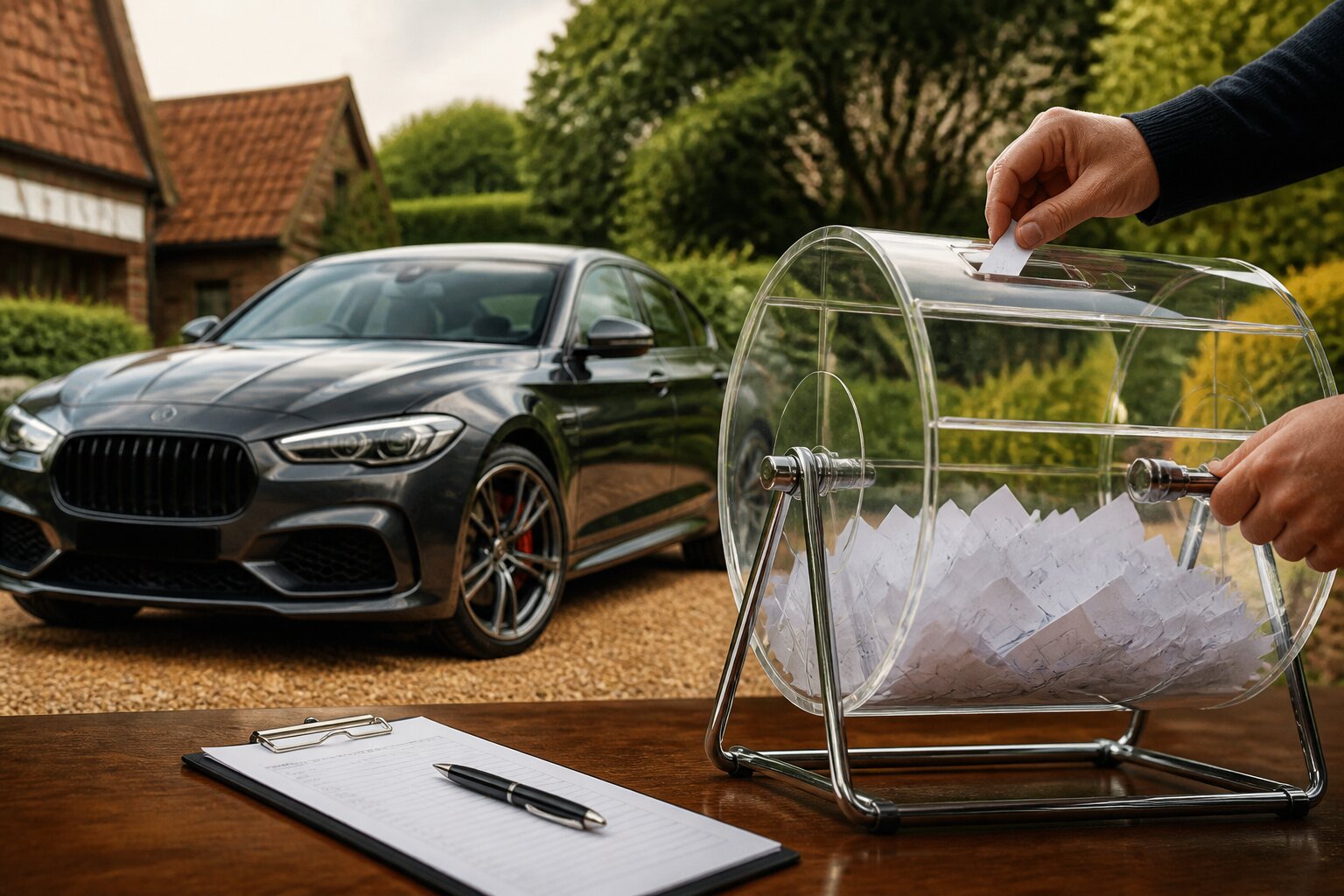
Ever spotted those tempting social media posts promising a brand-new Lamborghini for just a few pounds? It’s easy to feel a rush of excitement—and to wonder if there’s more than meets the eye.
Believe it or not, most UK “car raffles” aren’t actually a straight lotteries. They are usually structured as prize competitions, often with a simple question to meet legal requirements rather than a genuinely hard challenge. Because there is a skill element, however small, they generally sit outside the Gambling Commission’s direct rules, and organisers must offer a free entry route that is genuinely accessible.
That legal framing doesn’t change the maths or the trust issues that matter most to entrants. Read on to see how these draws are run, how to judge your real odds and value, and what to watch for when choosing where to enter.
What Are Car Competitions And How Do They Work?
Most car competitions in the UK are run as prize competitions or free draws, not traditional lotteries. Entrants must usually be aged 18 or over.
An operator sets a clear ticket price and publishes a maximum number of entries that will ever be sold. Individuals can buy one or more tickets, sometimes with per-person limits. Many competitions include a skill‑based question intended to distinguish a prize competition from a lottery; alternately, organisers must offer a genuinely free entry route, typically via ordinary UK post, that is no less convenient or costly than paid entry. This legal choice is central to how competitions are presented and operated.
When entries close, the organiser conducts a transparent draw. That could be a certified random-number generator with an audit trail, a live-streamed draw, or an independent observer to verify physical draws. After the result is confirmed, the winning ticket is announced and the organiser arranges prize delivery or offers a cash alternative. Fairness depends on clear ticket caps, equal treatment of paid and free entries, and verifiable draw methods.
Knowing this structure makes it easier to read the numbers that follow and to decide whether an entry represents genuine value. Next, we’ll break down how the odds are calculated so those numbers make sense.
How Do Odds Really Work In Car Raffles?
Your true chance depends on the competition’s ticket model. Most UK car raffles use a fixed-ticket model: a maximum number of tickets is set, and your odds are one divided by the total tickets. For example, 10,000 tickets means a one-in-10,000 chance for a single ticket; five tickets gives five-in-10,000, or one-in-2,000.
Where advertised odds can mislead is when the draw proceeds even if it does not sell out. A draw capped at 10,000 tickets but only selling 4,000 means your single-ticket chance is one-in-4,000, not one-in-10,000. That difference can materially improve your chance relative to the headline figure.
What Is A Fixed-Ticket Draw And How Does % Sold Affect My Chance?
A fixed-ticket draw limits entries to a set maximum. The advertised odds assume every ticket will be sold; they are only accurate at the cap. If the field remains undersold at draw time, each paid ticket represents a larger share of the pool and your effective odds improve. Operators rarely guarantee a sell-out, so watching the percentage sold near the closing date gives a practical view of your real chance.
How Is Value Ratio (Ticket Revenue ÷ Prize Value) Used To Compare Draws?
Value ratio compares potential revenue to the prize’s cash value and helps assess whether a draw offers reasonable value. Multiply ticket price by maximum tickets to get potential revenue, then divide by the prize’s cash equivalent. A ratio close to 1 suggests the organiser is returning most intake into the prize; a higher ratio indicates more of the income is covering costs or profit. For example, a £30,000 car with £1.50 tickets and a 40,000 cap gives a ratio of 2.0, while the same car with a 105,000 cap yields a ratio of 5.25. Lower ratios generally mean better value for entrants.
Understanding both percentage sold and value ratio gives a clearer picture than the headline odds alone. With that in mind, the next section shows how to spot draws that genuinely improve your position.
Are Car Competitions Legal And Legitimate In The UK?
Car competitions in the UK are typically run as free draws or prize competitions rather than lotteries, so long as they comply with the Gambling Act 2005 and associated guidance.
What Makes A Car Competition Lawful Under The Gambling Act?
A free draw requires a genuinely free route of entry, such as sending a postcard via standard-rate Royal Mail. That free route must be clearly promoted alongside paid entry and treated equally in prize allocation. Organisers meeting these conditions do not need a UK Gambling Commission licence.
A prize competition must demand sufficient skill, judgement or knowledge to deter many entrants from winning. Simple multiple-choice questions rarely meet that threshold. Where a skill element is genuinely challenging, no free entry route is necessary and the competition remains lawful without a licence.
Does Every Competition Need A Free Entry Or Skill-Based Route?
Yes. To avoid being classed as an illegal lottery, a competition must either offer a compliant free entry route or include a genuinely challenging skill element. Without one or the other, the competition risks being treated as a lottery and could face enforcement or licensing requirements.
Next, we’ll look at practical ways to find competitions that give you better odds or more value for your money.
How Can You Find Competitions With Low Odds Or Best Value?
Spotting better-value draws comes down to knowing where to look and which figures to read.
Seeing how many tickets are sold against the total available is the single most useful indicator. A 30,000-cap draw that shows only 600 sold near closing implies about a one-in-600 chance for a single ticket. Watching percent-sold, especially close to the draw, reveals whether the advertised odds are realistic.
There are dedicated comparison tools that make this easier. RaffleScout and Raffle Genius show live odds, prices and closing dates for car competitions, helping to compare multiple draws at once. Competition Showroom ranks active car draws by value ratio and updates odds based on tickets sold. Competition Checker summarises odds, value and trust signals, while CarRaffleOdds provides refreshed odds, ticket prices and value-per-pound metrics. RaffleRadar highlights new or undersold draws by showing percentage sold, prize value and closing times. These services let you filter by transparency and value rather than relying on marketing copy.
When assessing a draw, check ticket‑sold numbers, the value ratio, and trust signals such as clear terms, company details and independent verification methods. With those checks in hand, it becomes simpler to choose entries that offer genuinely better chances. The following section describes a few operators that regularly score well on those measures.
Which Operators Offer The Best Odds?
No single operator guarantees the best odds all the time, but some names consistently appear favourably in comparisons for offering closer prize-to-ticket proportions and clear terms.
Operators such as Bonkers Competitions, BMX Bounty, and Rafflee often show average value ratios around 1.4 to 1.5, indicating a relatively high proportion of ticket revenue available to fund the prize. RLings Competitions also appears in tracking tools with median value ratios under 2x, which signals decent prize-to-ticket pricing.
Comparison sites including Prize Scout, RaffleScout, RaffleCompare, and CarRaffleOdds do not endorse specific operators but provide filters for odds, value and transparency. They display independent ratings, live odds and reliability indicators such as Trustpilot scores and Voluntary Code status, which help form a clearer view of which organisers behave transparently.
Use those tools to verify UK-GC licensing where applicable, examine prize-to-ticket ratios and confirm clear delivery and cash-alternative terms. That approach helps prioritise competitions run with accountable practices rather than marketing alone.
How Do Cash Alternatives And Delivery Terms Affect Value?
The advertised retail price of a car is rarely the full story. Many organisers offer a cash alternative that is noticeably below the headline value—commonly in the 70% to 85% range of the retail price—because that is the realistic amount they are prepared to pay out. Always treat that cash figure as the practical prize value, since it is what a winner would actually receive if they choose that option.
Delivery arrangements also change the effective value. Some organisers include delivery within mainland Great Britain, while others require the winner to collect the car or to pay transport if they live in locations such as Northern Ireland or offshore islands. There may also be differences in what is included up front: short-term driveaway insurance, initial road tax, or a full tank of fuel are occasionally provided, but not guaranteed.
Running and transfer costs matter too. Immediate insurance, MOTs, or road tax requirements can create expenses after the prize is claimed. All these factors reduce the net benefit of winning compared with the shiny retail figure. Considering the cash alternative, delivery terms and likely upkeep costs together gives a clearer sense of the real value being offered.
With the prize value clear, the next section explains what happens once a draw concludes so you know what to expect if you enter.
When A Car Competition Ends, What Happens Next?
After the draw closes, organisers follow a sequence intended to be fair, verifiable and secure.
The draw procedure itself may use a secure random-number generator with a verifiable audit trail, be live-streamed on social media, or be overseen by an independent observer in a physical draw. Reputable operators preserve recordings or publish the seed and ticket count so entrants can check the result.
Once the winner is identified, the operator announces the winning ticket number and often publishes the winner’s surname and county with consent; some operators include a photo or full name when the winner agrees. Public disclosure reassures other entrants that a genuine prize has been awarded.
The operator will then contact the winner by standard UK methods and ask for identity verification such as a passport or driving licence plus proof of address. These checks are routine and help prevent fraud.
Winners normally choose between the physical car and a cash alternative within a defined window—often 24 to 72 hours. If cash is selected, the payout is typically tax-free and processed once verification is complete. For a vehicle, the organiser arranges delivery or collection according to the advertised terms, which may include free delivery within mainland Great Britain or require the winner to cover transport costs.
Each of these steps is part of the chain that turns a ticket into an actual prize, and transparent operators make those steps easy to follow and verify.
The Bottom Line: Car Competitions in the UK
Car competitions can be enjoyable, but the sensible path is to treat them as light entertainment rather than an investment. Prioritise operators that publish clear ticket caps, up-to-date tickets-sold figures, straightforward cash-alternative values, and verifiable draw methods. Use comparison tools to see live odds and value ratios, and read the delivery and verification terms so you understand the true prize.
Enter sparingly, within a budget you control, and choose draws that demonstrate transparency and fairness. If participation ever ceases to feel enjoyable or becomes a problem, support and guidance are available from organisations such as GamCare and the UK Gambling Commission. Finally, remember that a well-informed entry is the best way to enjoy the excitement without unpleasant surprises.
**The information provided in this blog is intended for educational purposes and should not be construed as betting advice or a guarantee of success. Always gamble responsibly.