
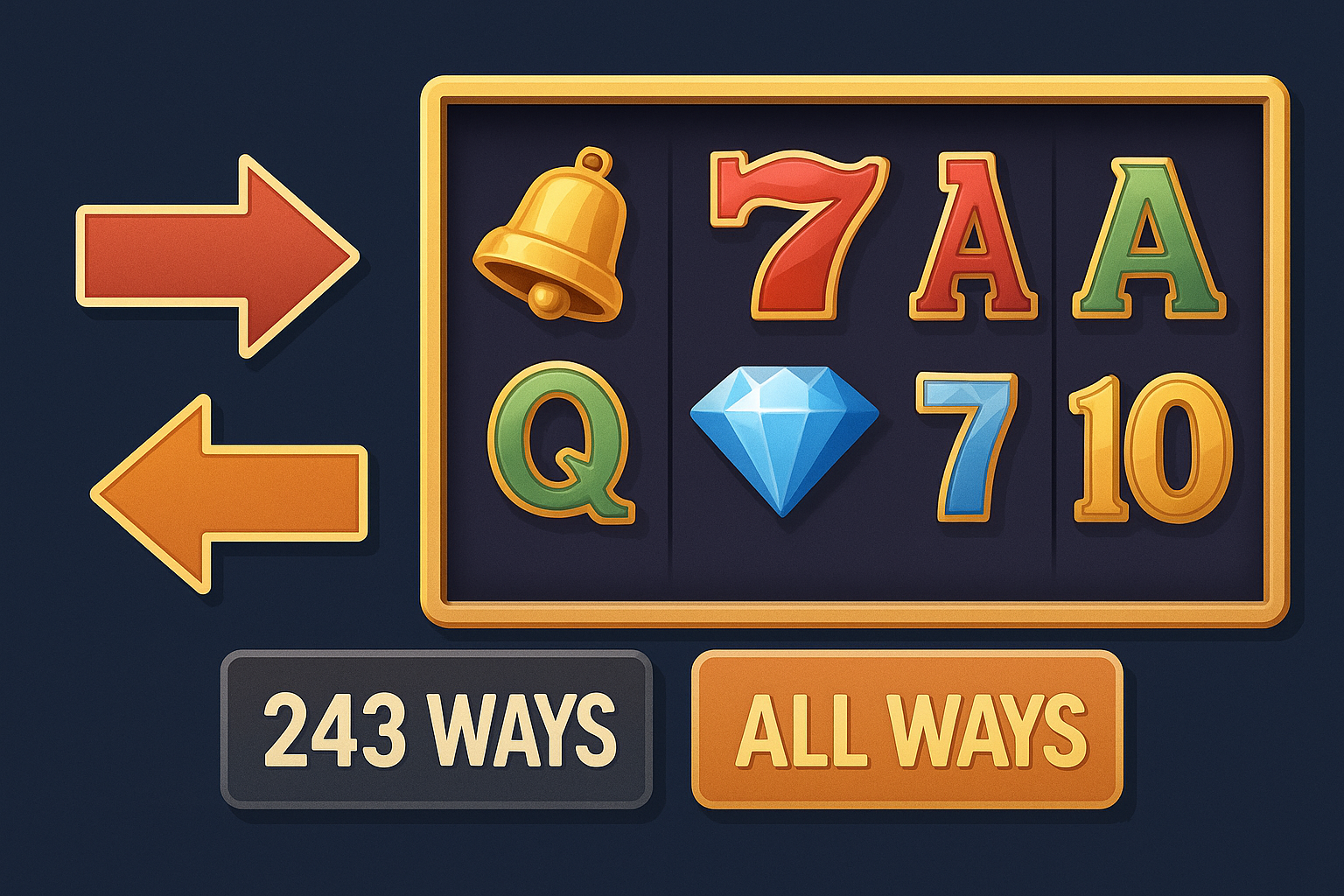
Ever noticed slot games talking about “ways to win” instead of traditional paylines? If you’ve wondered what that actually means, you’re in the right place. Understanding how these ‘ways’ work makes the mechanics behind modern slots much clearer and more interesting.
This post explains the main types of ways, how features like “win both ways” change payouts, and what to look for in a game’s paytable and RTP. Read on to get a complete picture so you can spot the differences between game types and choose what suits your style.
What Does "Ways" Mean on Slot Machines?
“Ways” refers to the different possible combinations that can produce a payout without relying on fixed lines across the reels. Instead of counting symbols only on specific paylines, ways count matching symbols on neighbouring reels, usually from the leftmost reel across.
In practical terms, a game that advertises 243 ways has 243 possible symbol arrangements that meet the required pattern for a win. The key point is that position on each reel matters less than the sequence across consecutive reels — a winning set can appear in any slot on the reel as long as the reels are adjacent and the symbols line up in sequence.
Because every spin typically covers all possible ways automatically, players don’t have to activate payline patterns or worry about missing a combination. The system changes how combinations form, not the fundamental maths behind the game.
Types of Slot Ways: 243, 1024 & More
Slots use a variety of ways structures depending on reel and row counts or built-in mechanics. The number of rows per reel is the main driver: add rows and the number of combinations grows rapidly. Ways are calculated by multiplying the number of visible positions on each reel, so a small change in rows can produce a big change in total ways.
243 Ways
Common on games with 5 reels and 3 rows, 243 ways means each reel position contributes to many possible left-to-right sequences. Mathematically this is 3 x 3 x 3 x 3 x 3, so any matching symbols on consecutive reels starting from the first reel can form winning combinations without fixed paylines.
This setup tends to feel familiar and straightforward. Payouts occur when matching symbols appear on adjacent reels, so wins are relatively frequent compared with sparser grids, though individual payouts may be smaller.
1024 Ways
Found on titles with 5 reels and 4 rows, 1024 ways increases potential combinations by adding an extra row to each reel. The calculation is 4 x 4 x 4 x 4 x 4, which creates a much denser grid of possible outcomes.
That expanded grid gives more positions where symbols can land, creating a denser set of outcomes and changing how often combinations form. Players may notice a different rhythm to spins and a shift in volatility compared with 243-way games.
Other Ways
Some modern mechanics change the number of symbols per reel on each spin, producing much larger totals. Examples include:
- 4096 ways, typically from a 5-reel game with 8 rows (8 x 8 x 8 x 8 x 8)
- 117,649 ways, often from setups with 7 symbols on each of 6 reels (7^6)
- Dynamic systems such as Megaways, which vary the number of symbols per reel on every spin and can produce very large and varying totals
These systems alter the reel structure dynamically and so produce a different feel and volatility compared with fixed-row games. Dynamic reels can create occasional big bursts of combinations, but they can also lead to longer dry spells between significant wins.
If you prefer a steadier frequency of smaller wins you might favour lower-way counts. If you like the chance of larger combinations and bursts of activity, higher counts and dynamic reel systems tend to offer that, though they also change how often wins appear and how volatile sessions feel.
What Is Win Both Ways in Slots?
‘Win both ways’ lets a game pay matching combinations that start from either edge of the reels: the usual left-to-right method, plus right-to-left. That effectively doubles the directional routes a symbol sequence can take.
This feature changes how payouts are counted but does not alter the underlying return behaviour of the game. The paytable will specify whether the extra direction applies to all symbols or only to specific combinations, and whether it interacts with other features such as multipliers or bonus rounds.
A quick look at any game’s information screen shows whether it pays both ways and how that is reflected in the payouts. Knowing this helps you understand why some spins seem to produce more visible winning lines even when the reel layout is the same.
What Are All Ways Slots?
“All ways” slots mean every position on each reel is active and any matching symbols on neighbouring reels can generate a win, provided they appear in the required sequence from the leftmost reel. There are no selectable paylines to activate.
This system simplifies the player’s view of the reels: you concentrate on symbol clusters across reels rather than tracking specific lines. It’s particularly common in modern video slots, where developers favour larger grids and symbol-rich displays.
Bear in mind that “all ways” simply describes the coverage of possible combinations; individual payouts and feature frequency remain determined by the game’s paytable and internal maths.
Are "Ways" Slots Better Than Paylines?
Myth-Busting: Are More Ways Always Better?
The number of ways affects the structure of possible outcomes but does not inherently increase a game’s payout rate. Games with large numbers of ways can produce many small wins and occasional larger ones, while payline-based titles may show fewer but visually clearer winning lines.
Which you prefer depends on whether you enjoy constant activity across the reels or the more traditional feel of lined wins. Think about what makes the session enjoyable for you rather than assuming more ways equals better returns.
The most important factors to compare between any two games are:
- Paytable — what each symbol and feature actually pays.
- Volatility — how frequently wins occur and how large they tend to be.
- RTP — the theoretical return to player over the long run.
These elements explain how wins are distributed and how often certain sizes of wins occur, and they are far more informative than the raw count of ways.
Myth-Busting: Are More Ways Always Better?
Even when games advertise very high numbers of ways, pay distributions remain a product of the game’s design. Dynamic systems that increase ways on certain spins can offer exciting variability, but they do not change the statistical balance set by the RTP and the paytable.
Choose games based on the experience you enjoy and the risk profile you are comfortable with. If you are unsure which style you prefer, try a few titles in demo mode to see how the reel behaviour and win patterns feel.
Play within your limits, set a budget before you start, and stop if playing stops being fun. If you feel you might have a problem with gambling, seek help from a recognised support organisation.
Where Can You Find "Ways" Slots at UK Casinos?
You will find many "ways" titles across online casinos and game libraries from a range of providers. Check the game information screen or the paytable to see whether a slot uses ways, paylines, or a hybrid approach, and to confirm the exact number of ways advertised. While you are there, it is sensible to note the stated RTP, volatility, and any special feature descriptions so you understand how the mechanic affects play.
Game filters and categories can make this easier. Some platforms let you sort by features such as:
- whether a game uses ways, paylines, or a hybrid system
- Megaways-style mechanics or adjustable reels
- the number of rows and reels
Those filters make it easier to compare similar titles and pick games with the mechanics you prefer. You can also use demo mode, read independent reviews, or check the developer’s pages for more detail before staking real money.
Stick to licensed UK-facing sites and operators with clear responsible gambling tools. That helps ensure the games are regulated and that you have access to deposit limits, session reminders, and self-exclusion options if you need them.
Understanding Payouts and RTP for "Ways" Slots
Payouts in ways-based slots are shown in the paytable as combinations of symbols across the required number of adjacent reels. The paytable also reveals special symbol behaviours, such as expanding symbols, scatters or multipliers that may interact with the ways mechanic.
RTP, or Return to Player, is a theoretical percentage indicating the long-run expected return from stakes to payouts. For example, a 96% RTP means the game is designed to pay back an average of £96 for every £100 played over a long period. It’s a modelled figure and does not predict short-term results for any particular player.
Volatility complements RTP by describing how wins are distributed: high volatility titles tend to pay less frequently but in larger amounts when they do, while low volatility games pay smaller amounts more often. Inspecting both RTP and volatility gives a clearer sense of what to expect from a game’s behaviour.
Summary: Choosing the Right "Ways" Slot for You
Choosing a slot comes down to personal preference and how you like wins to appear. Some players enjoy the steady action on mid-way counts; others like the dramatic swings that come with dynamic or very high-way games. Look at the paytable, RTP and volatility to judge how a game behaves rather than focusing only on the number of ways.
Set sensible limits on play and use the tools provided by operators to control time and spending. If gambling stops being enjoyable, support and advice are available from specialist organisations such as BeGambleAware and GamCare, and many platforms offer built-in controls to help manage play.
Enjoy exploring the different ways mechanics offer, and pick the games that fit your taste so the experience stays engaging and under your control.
**The information provided in this blog is intended for educational purposes and should not be construed as betting advice or a guarantee of success. Always gamble responsibly.