
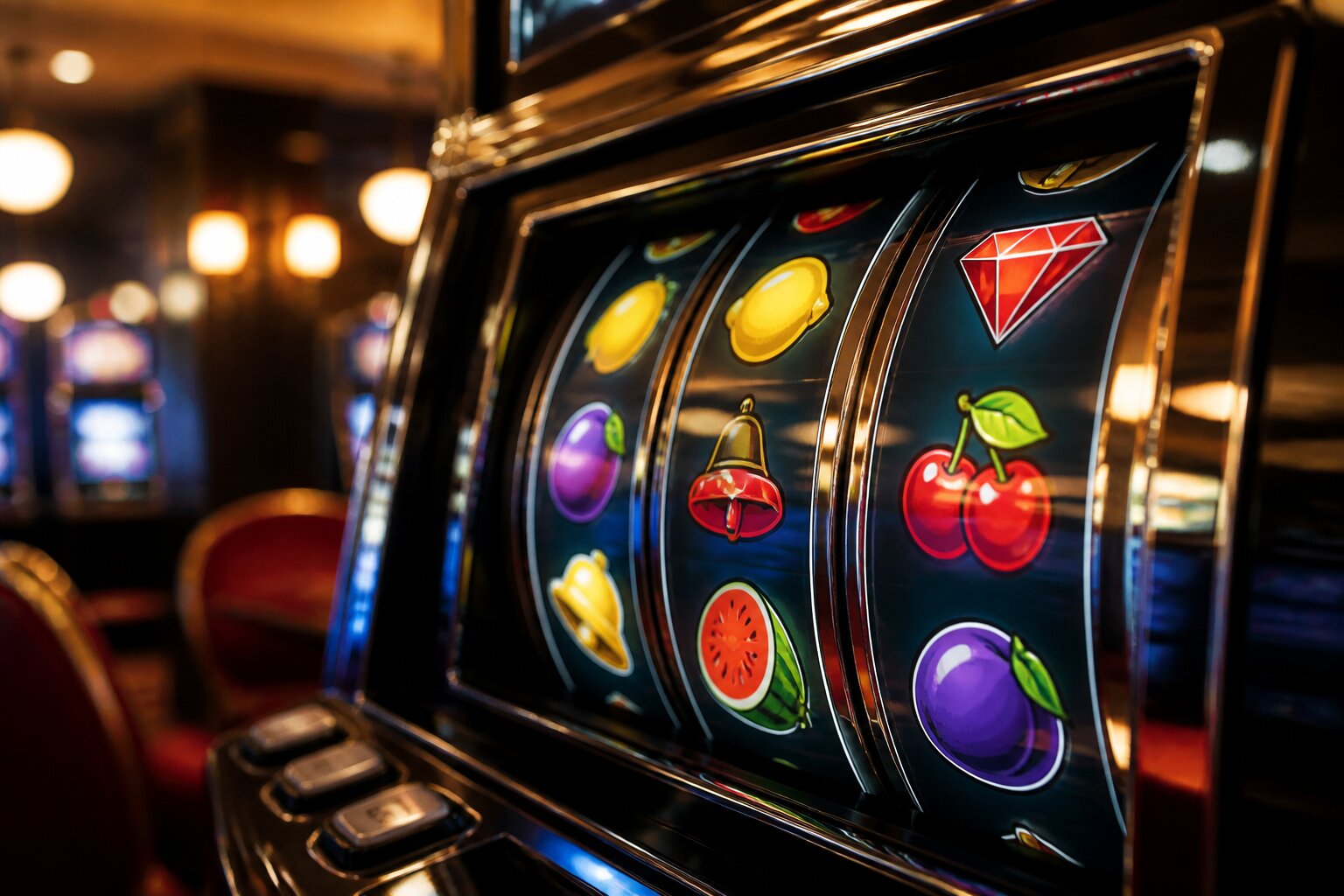
Ever wondered why some slot machines seem to pay out more often than others, or why certain symbols appear more regularly on the reels? The answer often lies in how many and what types of symbols are used on each machine.
Knowing how many symbols appear on a reel — and the roles they play — helps you understand the variety of outcomes a game can produce and why features such as bonus rounds or big payouts behave the way they do.
Keep reading to explore how symbols are organised, how they shape gameplay, and what that means for the kinds of wins a slot can offer.
What Are Slot Machine Reel Symbols?
Reel symbols are the images that appear on each reel and form the combinations that determine wins. Each spin generates a fresh alignment of these symbols; when the reels stop, specific patterns across the payline or grid trigger payouts or bonus features.
Symbols usually reflect the game’s theme. In classic machines those images might be fruit, bells, sevens and BAR icons; in modern video slots they can be items, creatures or characters tied to a theme. Beyond their visual role, some symbols carry special functions — a Wild can substitute for others to complete a paid line, and a Scatter can unlock free spins or bonus rounds when a required number shows anywhere on the reels.
Symbols also have frequency settings: designers choose how often each symbol appears on a reel, which directly affects how regularly certain outcomes occur. This setup leads into how traditional and modern games differ in their use of symbols and in the kinds of gameplay they produce.
Traditional vs Modern Slot Symbols
Traditional slots tend to use a compact set of recognisable icons such as fruit, bells, sevens and BAR symbols. These were chosen for clarity on mechanical reels and kept gameplay simple: the fewer the symbol types, the easier it is to spot winning combinations at a glance.
Modern video slots, however, layer in variety to support themes and features. Symbols might be jewels, artefacts, historical figures or themed items; many games also use animated or stacked symbols to create visual interest. Thematic symbols are often combined with multipliers, expanding symbols and other mechanics that change how a single symbol behaves on the reels.
This evolution from a small, fixed set to a broader, feature-driven array of symbols impacts how games feel and play. The way symbols are distributed on reels in modern titles is the next topic to consider, since that distribution controls the mathematical structure underpinning every spin.
How Many Symbols Are Usually Found on a Reel?
Symbol counts vary by game type and whether the machine is mechanical or digital.
Mechanical three-reel machines normally carry between 10 and 20 symbol positions per reel, because the physical reel can only accommodate so many distinct stops. Each visible symbol corresponds to one of those stops, and the physical limitation keeps combinations relatively simple.
Online slots use virtual reels, so developers can program many more positions — commonly 20 to 50 stops per reel, and sometimes even more. Those extra stops can include duplicates of the same icon, special symbols placed sparsely, or concealed positions that alter outcome probabilities without changing the visible layout. For example, a five-reel video slot might show three rows on screen while drawing from 30 virtual stops per reel; that design allows for more varied outcomes and complex bonus triggers while keeping the visible reels compact.
Understanding these differences helps when comparing the feel and volatility of classic and modern games, and it sets up how individual symbol types are chosen and repeated across reels.
Symbol Types and Their Common Counts
Symbols fall into two broad groups: standard symbols, which make up the bulk of the reel, and special symbols, which create the game’s extra features. The number of each type and how often they repeat is a key part of a game’s design.
Standard Symbols: Fruits, Bars, Numbers
Standard symbols are the workhorses of a slot’s paytable. In classic games these are items such as cherries, lemons, bells, BARs and sevens; in themed video slots they might be low-value themed icons or playing-card symbols dressed to match the setting. Most games include around 8–12 distinct standard symbols; each appears multiple times across the reel stops to fill the required positions and to shape payout frequency.
Because standard symbols are more common, they produce most of the routine, smaller wins players see. The exact counts and repetitions of these symbols are chosen to balance how often those smaller wins occur relative to bigger prizes.
Special Symbols: Wilds, Scatters, Bonus Icons
Special symbols are less frequent but have outsized effects when they do appear. Common types include Wilds, which substitute for other symbols; Scatters, which trigger free spins or other features when a set number appears anywhere on the reels; and Bonus symbols, which open dedicated bonus rounds.
A typical game will include one to three distinct special-symbol types, and these are usually placed sparsely — often one or two instances per reel or hidden among many virtual stops. Their scarcity is deliberate, because their function is to create occasional, higher-value events rather than frequent small wins. The way they are distributed is central to a game’s excitement and reward structure, which is explored further in the next section.
How the Number of Symbols Affects Gameplay
How many different symbols and how frequently they appear feeds directly into the mathematics of the game: the number of possible combinations, the rarity of particular patterns, and the balance between frequent small wins and rare big payouts.
Impact on Winning Combinations
Fewer distinct symbols means fewer possible combinations, which increases the relative frequency of matching lines. For instance, a three-reel game with 10 symbols per reel produces 1,000 possible outcomes, while 20 symbols per reel raise that to 8,000 outcomes. The larger the outcome space, the less often any specific sequence will appear, so designers use symbol counts to create rarer high-value combinations.
Modern slot designs exploit virtual positions and repeated symbol weighting to create both common and very rare outcomes. A high-value symbol might occupy just a single stop among many, making its appearance unusual, while lower-value symbols are repeated to deliver steady, smaller returns.
Effect on Payout Frequency
Increasing the number of distinct symbols or virtual stops tends to reduce payout frequency for any particular line, because there are more possible results on each spin. Game makers compensate by adjusting paytables, introducing bonus features, or clustering high-value symbols in ways that can still lead to engaging payouts. Volatility — how often and how large wins tend to be — is therefore shaped by symbol counts, repetition and feature frequency rather than by the visual number of icons alone.
Although outcomes are governed by random number generation and regulatory standards, the symbol layout and counts are the core levers designers use to create different playing experiences and payout rhythms. The next section explains why those choices vary between physical and online machines.
Why Do Online and Physical Slots Differ in Symbol Counts?
The divergence in symbol counts comes from the practical limits of physical hardware versus the flexibility of software.
Mechanical reels are bound by physical space: each stop must be printed and placed on a strip that fits the reel. That necessity kept symbol types and positions limited and predictable. Digital slots are not constrained in the same way; virtual reels can contain many more stops and can repeat symbols in precise ratios without any change to the on-screen graphics.
This software freedom also allows developers to include hidden stops, weighted symbols and complex feature triggers that would be impractical on a mechanical machine. Such options let modern games present a compact visual reel while drawing from an expanded set of virtual outcomes, enabling more varied feature design and fine-tuned payout structures. With that context, it’s easier to see how symbol counts relate to jackpot design and prize scaling.
The Relationship Between Reel Symbols and Jackpot Potential
Jackpots are tied to how rare certain symbol combinations are, and rarity is controlled by symbol type counts and placement. When many symbol types exist or when high-value symbols occupy only a few stops, the number of possible combinations grows, and specific jackpot-winning alignments become less frequent. That scarcity allows for larger jackpot values, because the game will reach such payouts only occasionally.
Some games designate special jackpot symbols or sequences that must appear in rare configurations to award the top prize. Progressive jackpots often rely on these mechanics so that a large prize can accumulate and be won under clearly defined, low-probability conditions. Designers balance the jackpot amount with how often the triggering pattern can realistically occur, using virtual stops and symbol weighting to deliver the intended frequency.
Understanding this link between symbol rarity and jackpots helps explain why some games advertise very large top prizes yet have comparatively few large wins over time. With the technical background in place, readers can now compare games’ symbol structures and payout styles with more clarity.
This overview shows how something as simple as the number and placement of reel symbols influences the whole playing experience — from routine payouts to rare jackpots — so it is worth checking a game’s paytable and feature descriptions when evaluating its style and volatility.
Play Online Slots at No Deposit Slots
We’re delighted to welcome you to our site, where you can enjoy a relaxed and friendly casino experience at your own pace. Our community is all about having a great time together and exploring the world of online slots.
**The information provided in this blog is intended for educational purposes and should not be construed as betting advice or a guarantee of success. Always gamble responsibly.