
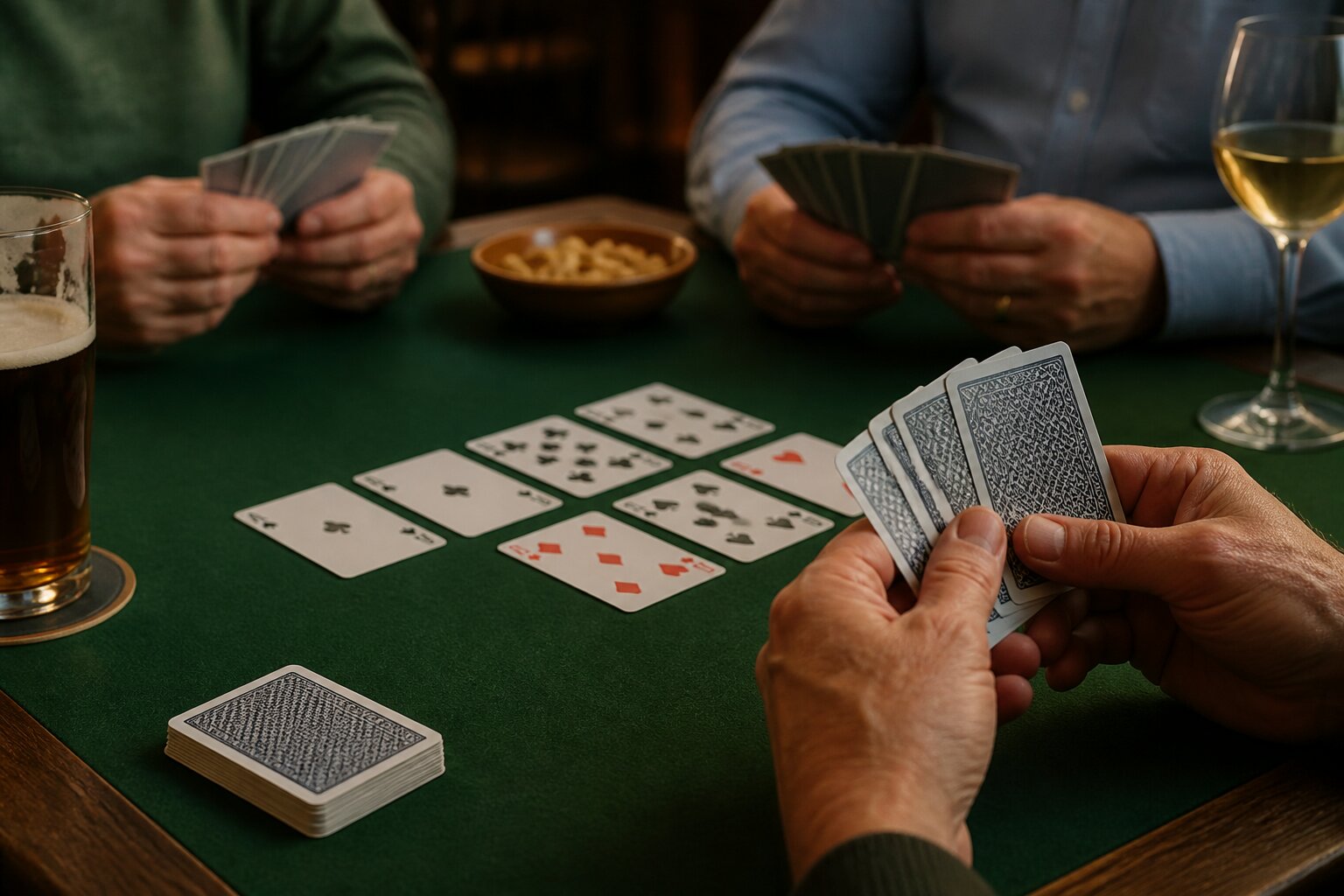
Looking for a new card game that’s fun, fast and easy to learn? Pontoon puts a fresh spin on classic 21-style play, with brisk rounds and a few distinctive rules that change the strategy.
This guide covers the essential rules, card values and common terms you’ll need to follow a game, plus how the dealer operates and how Pontoon differs from other card games. Read on to get a clear picture of how a round unfolds and what to watch for at the table.
Responsible gambling note: Pontoon is intended for adults over 18. Set and stick to limits you can afford.
What Is Pontoon?
Pontoon is a British variant of blackjack in which players compete only against the dealer to make a hand as close to 21 as possible without going over. The best possible hand is a Pontoon: an Ace together with a 10-point card.
Rounds are typically quick: players place bets, receive two cards and then decide how to proceed with those hands. The game’s combination of simple card totals and a few special hand rankings gives it a clear structure while still rewarding careful decisions.
Pontoon’s focus on player-versus-dealer play keeps the table social without the need for bluffing or side betting. Next, we’ll look at how a typical round progresses and what choices each player faces.
How Do You Play Pontoon?
Play begins with bets placed and two cards dealt to each player and the dealer. Players see only their own cards; the dealer’s cards remain hidden until it is their turn to act. From a player’s perspective, there are several standard moves they can make to change a hand’s value.
A player may twist to take another card in an effort to improve the hand, or stick to keep the current total. Buying is a distinct option that increases the bet in exchange for a further card; this is used when a player judges the extra risk worth the potential gain. Hands that exceed a total of 21 immediately lose as busts.
After every player has completed their decisions, the dealer reveals their hand and follows fixed rules for taking cards. The round ends when dealer and player hands are compared and payouts are settled. With that in mind, the next section explains the values of the cards and the specialised terms you’ll see used around the table.
Pontoon Card Values & Terminology
Understanding card values and common terms makes it much easier to follow decisions during play. Below are the main values and phrases used in Pontoon, each with a brief example.
- Ace – Worth 1 or 11 points, whichever benefits the hand (for example, Ace + 9 can count as 10 or 20).
- Number cards (2–10) – Valued at their face number (a 6 is worth 6 points).
- Face cards (Jack, Queen, King) – Each counts as 10 points (a King equals 10).
- Pontoon – An Ace plus a 10-point card, the highest hand (for example, Ace + Queen).
- Five Card Trick – Five cards totalling 21 or less (for example, 2 + 3 + 4 + 5 + 6 = 20).
- Bust – A hand that exceeds 21 and loses immediately (for example, Queen + 9 + 6 = 25).
- Twist – Requesting an extra card to improve a hand (for example, taking a card on 12).
- Stick – Keeping the current hand and ending the turn (for example, stopping on 19).
- Buy – Increasing the stake to receive an extra card beyond the normal options (for example, putting up extra to take a third card).
- Dealer – The house representative who deals and plays against the players.
With the vocabulary in place, it’s useful to see how the dealer’s role and obligations shape the later part of each round.
How Does the Pontoon Dealer Operate?
The dealer always acts after the players and follows firm rules about taking cards. Both of the dealer’s initial cards are dealt face down and remain hidden until play among the players is finished.
When it is the dealer’s turn, they must twist until reaching at least 17. A soft 17 — an Ace with cards adding to six that can count as 7 or 17 — is treated as needing another card, so the dealer will twist on it. Once the dealer’s total is 17 or higher, they must stick even if players have higher totals.
If the dealer exceeds 21, they bust and the remaining players win. These strict procedures create predictable end-of-round action and determine how hands are settled, which leads naturally into the ways a player can win or lose a hand.
Winning a Hand in Pontoon
Winning depends on having the best qualifying hand against the dealer at the round’s end. There are a few distinct outcomes to be aware of.
A Natural Pontoon (Ace plus a 10-point card) outranks any 21 made with more than two cards and will beat a dealer’s multi-card 21. A regular 21 made with three or more cards ranks below a Pontoon but above other totals. The Five Card Trick is another strong result: holding five cards totalling 21 or less will beat a dealer’s ordinary 21 if the dealer does not hold a Pontoon.
If a player’s hand exceeds 21, it is bust and loses instantly, regardless of the dealer’s result. Similarly, ties are normally resolved according to house rules, but a player’s Pontoon typically pays better than other winning hands.
These distinctions between Pontoons, regular 21s and five-card hands change how players value twisting, sticking or buying, and they help explain why certain choices are made at the table. Next, we’ll compare Pontoon to other familiar casino card games so you can see where it sits among them.
Comparing Pontoon to Other Casino Card Games
Pontoon shares family likenesses with other games but also differs in important ways that affect strategy and experience.
Pontoon versus Blackjack
One clear difference is that both dealer cards are face down in Pontoon, so players have less visible information when deciding whether to twist or buy. Also, a two-card Pontoon always beats a multi-card 21, which alters how two-card totals are valued compared with blackjack.
Pontoon versus Baccarat
Baccarat uses a scoring system where only the final digit matters and players cannot choose to take extra cards; all deals follow set rules. Pontoon, by contrast, allows player decisions that directly change a hand’s composition and total.
Pontoon versus Poker
Poker centres on betting rounds, hand rankings like pairs or flushes, and psychological play between opponents. Pontoon is a totals-based game where players do not compete against one another but aim to outscore the dealer without exceeding 21.
Each comparison highlights how Pontoon’s blend of concealed dealer cards, special hand rankings and player choice creates a game that is straightforward to learn but also rich in decision-making. Whether you prefer the direct confrontation with the dealer or the particular rewards for Pontoons and Five Card Tricks, Pontoon offers a compact, strategic alternative to other card games.
Final note: Pontoon’s rules create clear, rule-driven rounds with identifiable hand ranks and dealer obligations, so players can focus on reading their own hands and choosing the most appropriate actions at the moment.
Explore Casino Games at No Deposit Slots
At No Deposit Slots, you’re always welcome to become part of our friendly community of players. If you enjoy exploring different casino games, we’d love for you to join us and discover what makes us a favourite place to play.
Getting started is easy—just create an account, make a deposit, and you’re all set to play. We look forward to seeing you at the tables!
**The information provided in this blog is intended for educational purposes and should not be construed as betting advice or a guarantee of success. Always gamble responsibly.