
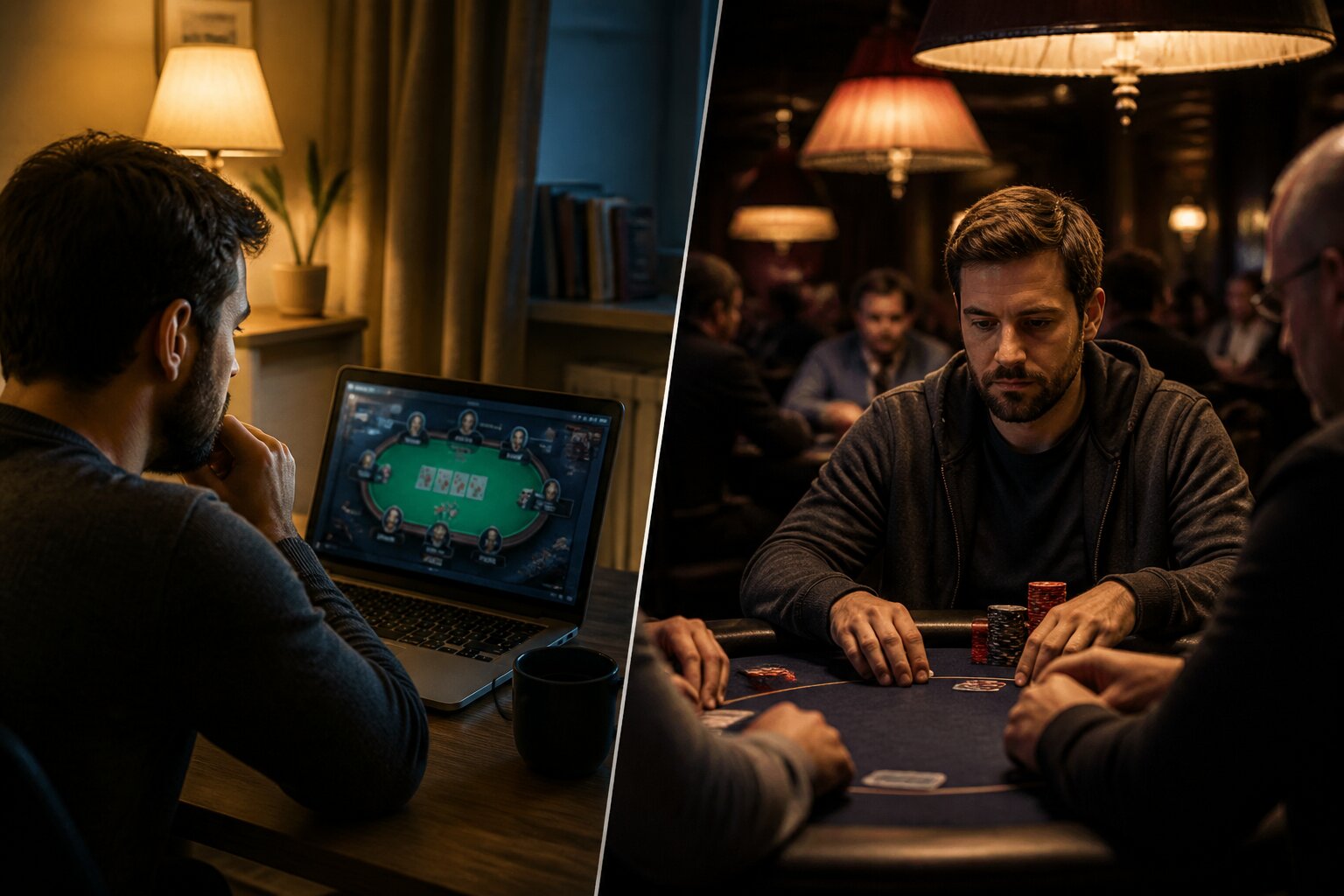
If you’ve ever played poker at your local casino or logged onto an online poker room, you might have wondered which one is tougher to beat. Some players say the digital tables are full of sharp operators, while others swear nothing beats the tension of a live game face-to-face.
Whether you’re tempted by the structure of online tournaments or prefer the immediacy of live play, opinions vary widely. Let’s look at the concrete differences that change how each game is played—so you can decide which setting suits you best.
Ready to settle the debate? Keep reading to see how environment, tools and behaviour shape the challenge.
Key Differences Between Online And Live Poker Environments
Online and live poker follow the same rules, but the settings produce very different experiences.
Online poker runs on software. Hands are dealt automatically, bet sizing is instant, and multiple tables are easy to open at once. Players appear as usernames or avatars, so physical tells are absent. The speed and anonymity encourage a focus on patterns and timing rather than body language.
Live poker centres on direct human interaction. A dealer deals cards, chips move by hand, and every facial expression or movement can be information. The pace is slower, which gives players more time to consider decisions and to build rapport or rivalries with regulars.
Anonymity and familiarity also diverge. Online tables can include players from many places with varied skill levels; live games are often populated by local regulars whose tendencies you can learn over time. Each environment therefore favours different skills: online players emphasise statistical tracking and rapid decision-making, while live players rely more on observation and social tactics.
These contrasts shape not only how you play, but which strategic elements are most valuable in each format.
Factors That Affect Your Poker Experience Online Vs Live
Choosing between online and live poker isn’t just about location—it’s about tempo, opponents and available tools. Several factors influence how challenging or enjoyable each version feels.
It’s worth thinking about which of these elements matters to you as a player.
Player Behaviour And Betting Patterns
Online, anonymity and speed produce different betting patterns. Players often use bet sizing and timing to convey strength or to probe opponents. That makes statistical reads and pattern recognition especially useful. In live rooms, behaviour is more nuanced: pauses, gestures and voice tones contribute to decision-making, and players may adopt more conservative lines when stakes or reputations are involved. Reading those subtleties can give an advantage, but they’re not foolproof and must be weighed against observed betting tendencies.
Pace Of Play And Game Flow
The rhythm of the game changes everything. Online sessions deliver many more hands per hour, which accelerates learning curves but also increases the mental workload. Multi-tabling amplifies that effect, requiring players to split attention across several spots. Live games produce fewer hands but allow for deeper consideration of each decision and a slower, more deliberate style of play. The trade-off is quantity versus depth: online play trains speed and pattern recognition, live play trains patient observation and interpersonal judgement.
Accessibility And Player Pools
Accessibility affects whom you meet at the table. Online platforms are available around the clock and draw a broad, international player pool with a wide spread of skill. Live poker is limited by location and opening hours, which tends to produce a smaller, more familiar set of opponents. That familiarity can help you exploit recurring habits, while online variety can expose you to a larger range of strategies to learn from.
Consider which combination of tempo, opponent variety and available information best supports your goals as a player.
Does Technology Make Online Poker More Challenging?
Technology is central to the online game and it changes what “challenging” means.
Tools such as hand trackers and statistical overlays help players spot long-term tendencies in opponents. These programmes can reveal weaknesses and inform strategy, but they require interpretation; raw numbers don’t replace sound judgement. Multi-tabling and rapid dealing demand excellent focus, quick pattern recognition and the ability to keep strategic principles consistent across multiple situations.
Platform features—automated dealing, standardised bet options and fast fold buttons—create a rhythm that rewards players who can maintain concentration and adapt quickly. For some this is an advantage, allowing rapid skill development and volume-based bankroll growth. For others it’s a test of discipline: more hands mean more chances to overextend, so mental stamina and strict session limits are important to protect decision quality.
Technology adds layers of complexity, but it also creates tools you can learn to use in your favour.
Common Myths About Online And Live Poker Difficulty
Many myths colour the discussion about which format is harder; separating fact from fiction helps you form a clearer view.
One frequent concern is the presence of automated programmes at online tables. Reputable sites have systems and policies to detect and prevent unfair automated play, and operators take action when suspicious patterns emerge. Another misconception is that seeing opponents in person makes live poker decisively easier. While physical tells can be informative, they are only one piece of evidence; sound play still depends on understanding ranges, position and pot odds. Finally, people sometimes say online games are “rigged.” In practice, regulated operators use audited systems to ensure card distribution is fair, and outcomes should be understood as distributions of probabilities rather than certainty.
Recognising these realities helps you focus on skills that matter in each setting, rather than getting sidetracked by myths.
Which Poker Setting Suits Different Types Of Players?
Different players find their strengths align with different environments.
Players who value convenience, a high volume of hands and the ability to practise many situations quickly tend to prefer online play. The pace suits those who enjoy numerical analysis and steady exposure to varied opponent types. Players who enjoy interpersonal dynamics, a slower pace and the chance to build reads over repeated encounters often favour live games. Social players may enjoy the human element and the strategic use of table talk and presence.
Some players blend both: using online play for technical improvement and live sessions for testing social strategies. Reflecting on your preferred pace, how you process information, and the types of opponents you want will guide you toward the setting that complements your style.
If you’re unsure, try balancing both formats in small amounts to see which develops your strengths most effectively.
How Do Social Interactions Differ Online And Live?
Social interaction is intrinsic to poker, but it looks very different online and in person.
In live games, conversation arises naturally and becomes part of the psychological landscape. Players exchange small talk, make bets with visible reactions and develop table dynamics that shape later hands. That direct human contact can be a source of actionable information, as well as a way to manage table image.
Online interactions are typically briefer and mediated by chat boxes or emojis, so behavioural data comes more from betting patterns than from speech. That can suit players who prefer to focus on the maths and mechanics of the game without social distractions. Both environments have norms about etiquette and fair play; maintaining respectful conduct helps the game run smoothly and keeps the focus on skillful competition.
Understanding these social differences will help you decide how to present yourself and what cues to pay attention to at each table.
Conclusion: Choosing The Best Poker Experience For You
Ultimately, the best poker setting is the one that matches your aims and strengths. Online poker rewards speed, volume and analytical tools, while live poker rewards observation, patience and interpersonal skills. Neither format is inherently superior—each asks for different competencies.
Think about the pace you enjoy, the kind of opponents you want, and how you handle information under pressure. Try both formats in measured sessions and let your experience guide you. Use available account controls to keep your play within comfortable limits, and aim to develop sound decision-making across whichever environment you choose.
Play thoughtfully, keep learning, and pick the setting that helps you grow as a player.
**The information provided in this blog is intended for educational purposes and should not be construed as betting advice or a guarantee of success. Always gamble responsibly.