
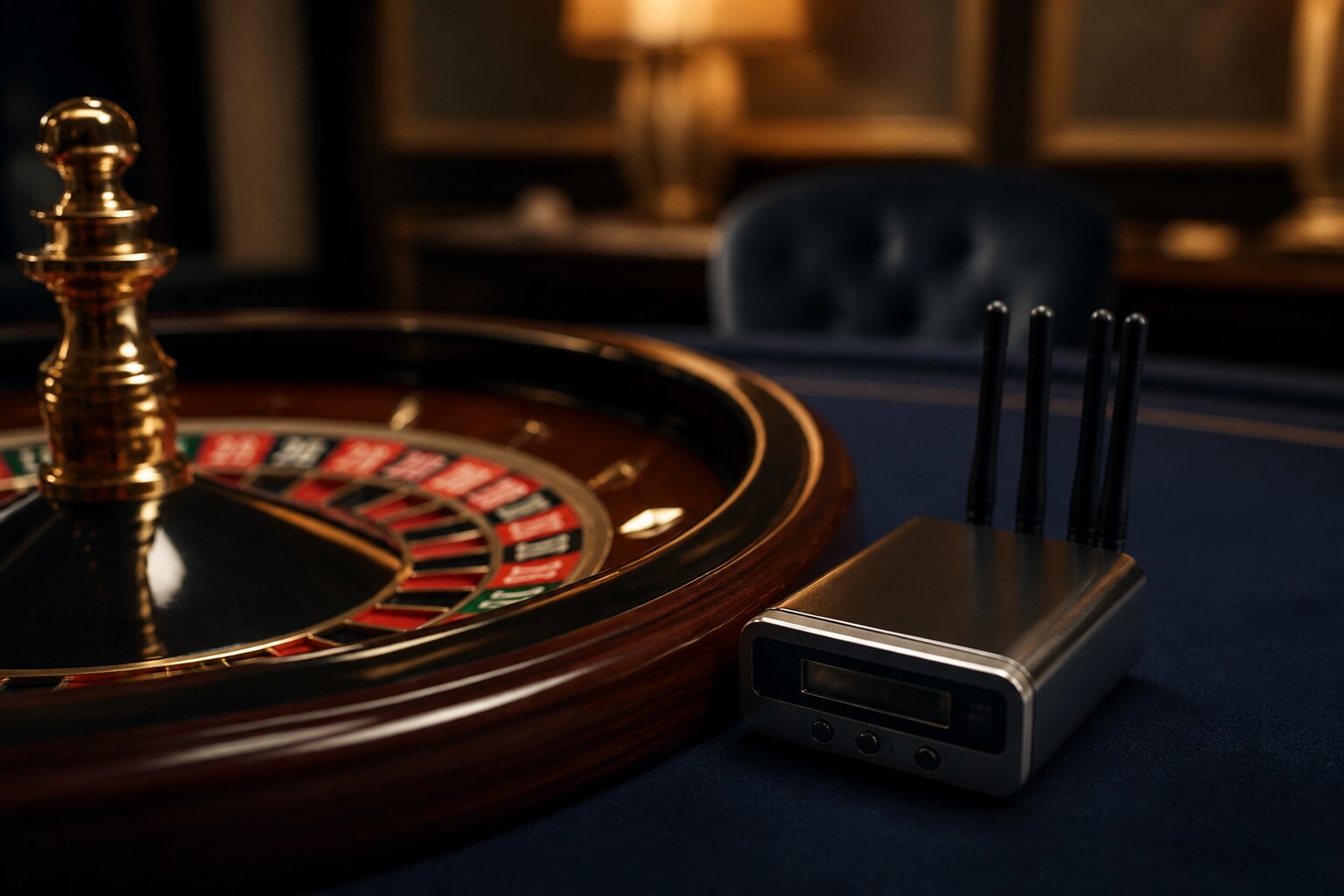
Imagine being able to predict where the roulette ball will land before the wheel even stops. The idea sounds straight out of a spy film, doesn’t it? That’s exactly what roulette computers claim to do—promise players an edge over the tables using small, rapid calculations.
Stories range from hidden gadgets to smartphone apps that claim to “crack the code”. Some are tall tales, others are plausible-sounding technical schemes. Read on and we’ll separate the technical theory from what actually happens in a casino, so you can see why these devices rarely deliver what they promise.
What Is a Roulette Computer?
A roulette computer is a compact device intended to estimate where the ball might finish on a spinning wheel. It gathers inputs such as wheel rotation and ball speed, runs a quick calculation and returns a zone of numbers that it considers most likely for that spin.
These devices appear in several forms: purpose-built electronics, discreet phones with apps, or wearable units. Typically the user times the release and then presses a button so the device can compute its prediction in the short window before the ball falls.
In principle this sounds technical and precise. In practice, however, the physics of the wheel, the short timeframe for useful data and the ways casinos design their equipment and procedures make reliable prediction very difficult. The rest of this article explains those complications and why the idea rarely survives scrutiny.
How Do Roulette Prediction Devices Work?
Most prediction devices rely on timing and motion data taken as soon as the ball is launched. The device estimates initial speeds and deceleration, then runs a model of the ball’s trajectory and the wheel’s rotation to produce a likely landing sector.
Some systems use basic physics approximations; others add empirical corrections based on prior spins. The rapid calculations have to be done while the ball is still travelling, which places demanding requirements on both measurement accuracy and processing speed.
Casinos are also a challenging environment: lighting, table surface variations and dealer technique introduce noise into measurements. Those factors, along with the short interval for calculation, mean that even well-designed devices face high uncertainty when used in real play.
Before we move on to legality, note that attempting to use these tools in a casino can have serious consequences. The next section covers legal risks in the UK and how venues respond.
Are Roulette Computers Legal in the UK?
Using prediction devices in a casino environment is illegal under UK law. The Gambling Act and associated rules prohibit any method that gives an unfair advantage or tampers with standard play, and venues treat the matter seriously to protect the integrity of their games.
Penalties for attempting to use such a device range from immediate removal from the premises and seizure of any disputed winnings to criminal investigation in more severe cases. Casinos also share information and may refuse entry to people suspected of using prohibited equipment.
Regulated operators maintain strict controls—regular checks, surveillance and staff training—to detect unauthorised devices and behaviour. That legal and operational framework is intended to ensure fairness for all players and to deter attempts to manipulate outcomes.
With legality and enforcement in mind, the next section looks at how effective these devices actually are in real-world casino conditions.
How Effective Are Roulette Computers in Real Casinos?
Claims of reliable, repeatable success for prediction devices are scarce and typically unsupported by robust evidence. Short-term winning runs are sometimes publicised, but they rarely translate into consistent, long-term gains when tested under normal casino conditions.
Modern casinos actively reduce variables that could be exploited. Surveillance teams monitor play, dealers vary spin speed and release points, and tables are regularly rotated and inspected. All these measures increase the variability that a device must overcome.
Even from a purely technical perspective, small inaccuracies in timing or measurement are amplified by the ball’s dynamics. That means a single mis-timed input can shift a predicted sector by many numbers. Taken together, these challenges make reliable prediction difficult to achieve and maintain.
To make that clearer, here are the main reasons devices struggle in practice.
Factors That Affect Prediction Accuracy
There are several technical and operational factors that undermine prediction attempts:
- Wheel design: Contemporary wheels are manufactured to minimise predictable biases and to reduce patterns that could be exploited.
- Speed changes: Dealers often vary the speed of the wheel and the ball between spins, which alters the underlying motion profile a device needs to model.
- Casino countermeasures: Regular inspections, swapping wheels and vigilant surveillance reduce consistent conditions that a prediction method depends on.
- Randomness built into play: The mechanics of the wheel and ball, combined with small variations at release and contact points, create outcomes that are highly sensitive to tiny differences in initial conditions.
These points help explain why theoretical models encounter large real-world errors.
Next, we’ll dispel some common misunderstandings that tend to circulate about these gadgets.
Common Myths About Casino Prediction Devices
Discussion online often confuses potential with proof. One persistent myth is that any device that “works” for a short period is a foolproof system; in reality, short-term patterns can be statistical noise and do not establish a reliable method.
Another misconception is that devices are impossible to detect. In truth, casinos employ multiple detection layers—visual observation, behavioural analysis and technical sweeps—that make concealment difficult. Claims of certain success are frequently associated with sales pitches for software or hardware that have not stood up to independent testing.
Occasionally you’ll see stories of a “perfect” system. Such anecdotes are typically incomplete or omit the broader context: how long the method worked, the conditions during the tests, and whether the results were repeatable. Scrutiny of those details usually reveals important caveats.
If you’re evaluating any claim, look for transparent testing under realistic conditions. Reliable reports will show consistent performance across varied situations and will disclose limitations rather than making absolute promises.
Risks of Using Roulette Computers in Casinos
Beyond legal consequences, attempting to use a prediction device involves other material risks. A person can be banned from one venue and potentially across a wider group of casinos. Any winnings linked to suspected use of a device are likely to be forfeited, and involvement in a legal process can be costly and disruptive.
There are also reputational risks; being associated with cheating allegations can have long-term personal and professional consequences. Technically, the devices themselves can fail or provide misleading output, which can lead to unexpected losses at the table.
It is worth emphasising that casinos actively pursue suspicious activity to protect play for everyone. Those protections are in place to ensure games remain fair and to deter attempts to exploit mechanical or human factors.
If you want a safer way to engage with roulette, the next section suggests practical alternatives that avoid those risks.
Safer Alternatives to Prediction Devices
If your interest is learning and enjoyment rather than attempting prohibited methods, there are legitimate approaches that enhance the experience. Understanding the game’s rules, different bet types and the statistical house edge gives you clear, factual context for making betting choices.
You can practise in free or low-stakes online versions to experience game pace and betting options without exposure to significant loss. Setting a budget and sticking to it helps keep play controlled and within your means.
Engaging with strategy discussions that focus on bankroll management and bet selection—rather than trying to circumvent game mechanics—offers a healthier, sustainable way to participate. These approaches let you enjoy the game while avoiding legal, financial and reputational risks.
Conclusion: Can Technology Really Beat the Roulette Wheel?
Technology can model aspects of a roulette spin, but in the casino environment those models face practical limits that usually prevent reliable, long-term success. Modern table design, active countermeasures and the sensitivity of the ball’s motion all combine to make dependable prediction unlikely.
Attempting to use prediction devices carries meaningful legal, financial and personal risks and is treated as cheating by venues. The safest and most rewarding approach is to play within the rules, understand the game’s structure, and use sensible money management so time at the tables remains enjoyable and trouble-free.
**The information provided in this blog is intended for educational purposes and should not be construed as betting advice or a guarantee of success. Always gamble responsibly.