
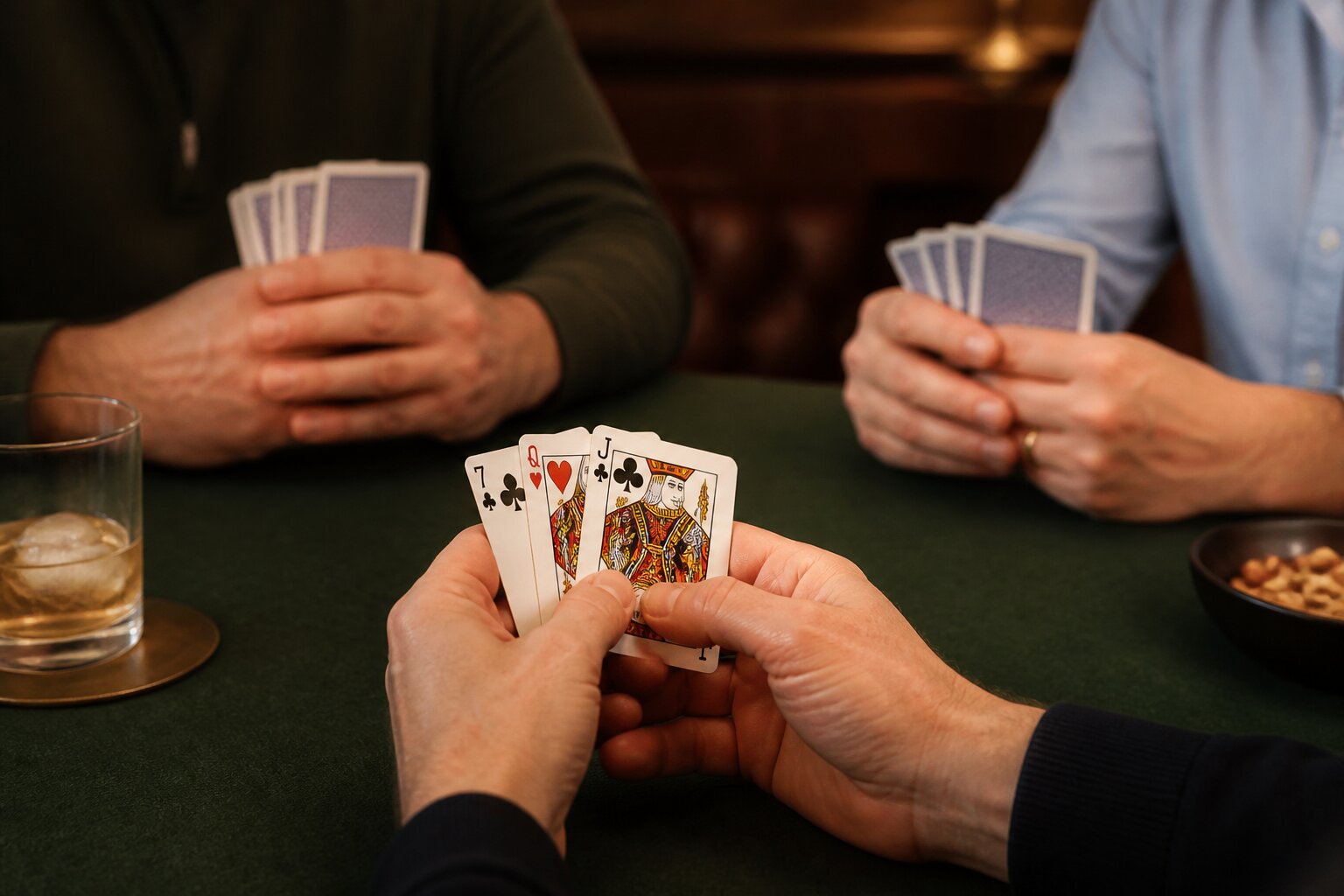
3 card brag is one of Britain’s classic card games, prized for brisk rounds and simple mechanics. It has long been played at family tables and in pubs, where small-stake social play is common. Myths and misunderstandings about hands, rules and strategy have grown up around it.
Whether you are a complete beginner or an experienced player refreshing the basics, this guide cuts through the confusion and explains what really matters at the table. Read on to learn the rules, see how play unfolds and uncover the truths behind common misconceptions.
Curious about which ideas are useful and which are just folklore? The next sections take you through the essentials step by step.
What Is 3 Card Brag?
3 card brag is a traditional British card game played from a standard 52-card deck. Each round moves quickly because players are dealt only three cards and betting is concise. The game’s distinctive hand order, where a prial, or three of a kind, ranks at the top, gives it a character different from many other familiar card games.
Play is usually social and compact. Players aim either to hold the best three-card hand at showdown or to persuade opponents to fold through betting. Bluffing and reading opponents play a part, but the compact hand size means decisions are straightforward and the tempo remains lively. Next, we will look at the basic rules so you can see exactly how a typical round progresses.
Understanding the Basic Rules
Each player receives three cards face down and a predefined stake is placed into the pot to start the round. Players privately view their cards; the action then moves around the table as people choose to continue by matching the current amount, raise the bet, or fold and exit the hand.
Betting proceeds clockwise. If a player raises, others must either match that raise or fold. Once a player folds they cannot win the current pot. If only one player remains after a sequence of folds, that player wins the pot without revealing their hand. If two or more players remain once betting ends, those hands are revealed and the highest-ranking hand wins.
Hands are ranked differently from many poker variants: a prial is highest, followed by a running flush, a run, and so on. Because rounds are short, decisions tend to emphasise immediate reads on the cards and the opponents rather than longer-term strategies. The following section explains what happens in a typical session and how the action feels in play.
How Do You Play 3 Card Brag?
At the start of a hand everyone places the agreed stake into the pot so all players begin on equal footing. Three cards are dealt to each player face down, and players inspect their own cards quietly. Play moves around the table with opportunities to match the current bet, raise the stake, or fold.
For example, a player holding 9♦ 10♦ J♦ has a running flush and might be willing to raise. Another player holding 4♣ 4♥ K♠ has a pair and may choose to call a moderate raise or fold to a large one. Bets continue until every active player has matched the last raise or folded. If more than one player remains, hands are shown and the strongest hand wins the pot.
Because rounds are brief, players must make clear, timely decisions. The game rewards paying attention to betting behaviour and the likely strength of opponents’ hands within the constraints of three cards. With that context, the next section dispels some common myths that often mislead newcomers.
Common Myths About 3 Card Brag
Many long-held beliefs about 3 card brag persist. Below are three widespread myths with clear explanations of the reality behind them.
Is 3 Card Brag Just a Game of Luck?
Cards are dealt randomly and no one can control which three cards they receive, so uncertainty is inherent. That said, players can influence outcomes through betting choices and psychological play. Deciding when to raise, when to fold and how to interpret opponents’ behaviour introduces skillful elements.
Success therefore comes from combining sound decision making with an understanding of probability and opponent tendencies, rather than relying solely on chance. Responsible play accepts the role of luck while focusing on decisions that reduce risk and manage stakes appropriately.
Can You Always Win With a Prial?
A prial is the top-ranked hand, but it does not guarantee an automatic win in every situation. If multiple players hold prials, the prial with the higher rank wins; for instance three Aces outrank three Kings. Also, a prial can go untested if opponents fold before a showdown, so a strong hand does not always translate to a contested pot.
Betting dynamics, position at the table and how other players respond to aggression all affect whether a prial secures the pot. It is also worth remembering that even the best hand can lose if betting patterns push opponents out, so prudence in both betting and risk management remains important.
Does Memorising Cards Guarantee Success?
With only three cards dealt to each player and fresh deals each round, tracking previous cards offers limited advantage compared with games that use community cards or larger hands. Observing how opponents bet provides more useful information than attempting to memorise discarded or played cards. Treat memory-based systems cautiously; they are rarely decisive by themselves.
Instead, use observations about betting patterns, timing and player tendencies to inform decisions, while recognising the limits of any memory technique in a fast-moving game. Combining modest memory aids with good bankroll management and realistic expectations will usually serve players better than overreliance on recall.
These clarifications lead naturally into an exact listing of hand rankings so you can put the guidance into practical perspective.
What Are the Key Hand Rankings?
Hand rankings in 3 card brag are specific to the game and differ from typical poker orderings. Below are the rankings from strongest to weakest with examples, along with a brief note on how each hand tends to behave during play.
Prial (Three of a Kind)
Three cards of the same rank. Example: 3♠ 3♥ 3♦.
This is the strongest possible hand in 3 card brag, and it will usually win against any other combination. Prials are rare, so when one appears it often changes the tone of the round and prompts stronger betting or folding decisions from other players.
Running Flush (Straight Flush)
Three consecutive cards of the same suit. Example: 7♠ 8♠ 9♠.
A running flush is the second strongest hand and combines sequence and suit. It is uncommon and typically beats runs, flushes and lower hands, making it a powerful holding when deciding whether to raise or call.
Run (Straight)
Three consecutive cards in mixed suits. Example: 4♦ 5♣ 6♥.
Runs are valued for their sequence but are less strong than running flushes because the suits do not match. They often win in heads up situations, but can be vulnerable to the rarer higher combinations.
Flush
Three cards of the same suit, not in sequence. Example: 2♠ 6♠ 10♠.
Flushes beat pairs and high card hands but lose to any kind of run or prial. Because they rely on matching suits rather than order, flushes can be relatively more common than runs in some deals.
Pair
Two cards of the same rank plus any third card. Example: K♣ K♥ 5♦.
Pairs are a solid mid strength holding and will usually beat any high card combinations. They are a common reason players choose to stay in a hand rather than fold, but they can be outmatched by all of the higher categories listed above.
High Card
Three different cards that do not form any of the above combinations. Example: A♠ 7♥ 2♦.
High card hands are the weakest and win only when no other player has a pair or better. In play they often lead to conservative betting unless the high card is particularly strong, such as an ace.
Knowing this order makes it easier to judge the strength of a hand during betting and to anticipate how opponents might respond. With the ranking clear, you can see how 3 card brag compares with poker and what that means for general strategy and risk management.
3 Card Brag vs Poker: What’s Different?
Both games involve betting and bluffing, but the differences shape how each is played. In 3 card brag each player has only three private cards and there are usually fewer betting rounds, so hands resolve quickly. Poker variants often deal more cards, include community cards and allow for more complex betting structures across multiple stages.
The hand hierarchy in 3 card brag prioritises the prial above all, which contrasts with many poker versions where flushes and straights occupy higher positions. The smaller hand size in brag reduces the scope for elaborate long-term strategies; instead play focuses on immediate assessment of relative hand strength and opponent behaviour.
Because rounds are fast, bankroll considerations are important: play with amounts that are comfortable for short, frequent rounds. Keep play to affordable stakes and avoid chasing losses; treating the game as entertainment helps maintain a healthy approach. With these differences in mind, you will find 3 card brag rewards clear-headed decisions and attentive reading of the table.
Final thought: 3 card brag offers compact, engaging rounds that are easy to learn but still give room for tactical choices. Armed with the rules, hand rankings and a sense of what matters at the table, you are ready to enjoy the game with confidence.
Ready to Try? Discover Casino Games at No Deposit Slots
Ever wondered what all the excitement is about? Step into our site and explore a world of entertainment with us.
Getting started is straightforward—just create your account, make a deposit, and you’re all set to play. We’d love to welcome you soon!
**The information provided in this blog is intended for educational purposes and should not be construed as betting advice or a guarantee of success. Always gamble responsibly.